In Buddhism we have a concept, a principle of sorts: to appreciate life as is it. To know one's self, as well as to know that one has no real self. I think Giuseppe Tornatore captures this ideal state in his movie The Legend of 1900. The movie is a biographical account of the life of Danny Boodman T.D. Lemon Nineteen Hundred (1900 for short), a man that was born, lived and died on The Virginian. When he was 27, 1900 met a man named Max that became almost obsessed with the idea of 1900 "leading a full life" and getting off the ship. He constantly tells 1900 of the life to be lived on land: finding a wife, getting a job, staring a family. "Life is lived out there," he tells 1900, pointing out past the gangway.
1900: “Why Why Why Why Why. I think land people waste a lot of time wondering why. Winter comes, you wish it was summer. Summer comes and you live in dread of winter. That’s why we never tire of traveling, always chasing some place far away where it’s always summer. Doesn’t sound like a good bet to me.”
(Did I mention 1900's a bad ass pianist?)
When examining the relationship between humans and technology it is good to always keep in mind the balance we must keep in our lives. How much of these advancements are the natural progression or evolution of being and how much of it is forced progress for the sake of progress. When do we go out searching for the horizon and when do we sit back knowing that soon the sun will rise with or without us?
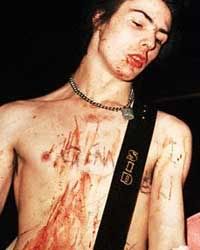 Ong and I strut a fine hairline fracture when talking about naturality. He starts by saying “There is no way to write “naturally.”(19) claiming that we must learn to write and use instruments not organic to our bodies while everyone beyond certain disabilities learns to speak. Why are these two activities so essentially different that one is considered unnatural? Would is be more natural is one use there own bodies to create words? Does Sid Vicious carving out letters onto his own chest in the middle of Sex Pistol concerts present a more natural setting for the written word? What about ancient writing systems, are those also un-natural? Studies of feral children show that without contact with human adults the children will loose the ability for oral speech. Why is a child that howls and runs around on all fours considered natural while one that sits up and speaks considered natural?
Ong plays somewhat of the devil's advocate is his piece before making his final points. He follows comments on naturality by saying, "Technologies are artificial, but -paradox again- artificiality is natural to human beings." (20) And although I still have qualms about the "natural" and "unnatural" essences of practices and objects, I will let the questions end here and conclude that practices and objects simply are. We chose whether to integrate them into our lives and society; whether to accept and make them natural to us.
One more point I'd like to touch on from Ong's article is how "Writing separates past from present." (22) The introduction of this piece seems to tell it's reader that because they have the ability to read the piece, they are lacking some other sensibility. Ironically, by having something we lose something else, in this case, the ability to think as non-literate thinkers do. (Not necessary illiterate, for oral cultures are considered non-literate, separate from literacy) “… without tremendous effort we cannot separate it from ourselves or even recognize its presence and influence.” (15)
In choosing literacy, we not only chose it for ourselves, but for those that come after us. In this, we should not portray literacy in the light of things we leave behind. We must know and examine what we leave behind while looking at what we gain ahead. Yes, writing separates past from present, but its that separation that creates a variety of knowledge that makes life interesting. It creates new disciplines, new history. We still forget, headstones crumble, memories are lost, but those things that important to us are immortalized for those that will come after us, and with the use of the internet, those memories are not stacked in some landfill, or in an underground library, they can be stored somewhere that is virtually endless (or appears endless, I actually have no idea how the internet really works). While writing separates past from present, we combine them internally through experience. We are still the time capsules carrying the past into the present, now we just have a sweet bag (like Mary Poppins) to carry more then we ever before imagined.
Although I found Ong's text interesting and thought provoking, I do not enjoy his style/format. I don't enjoy texts that make me wish for things I know I cannot have, it's a poinsonous state of thinking. We know how these new "technologies" help and hinder us and we have chosen our path. It is not a time to wait for summer, for summer is already here.
“Writing is a cousciousness-raising and humanizing technology.” (27)

No comments:
Post a Comment